




MISP-STIX 2026.11.12 released: MISP Extensions for STIX 2.1
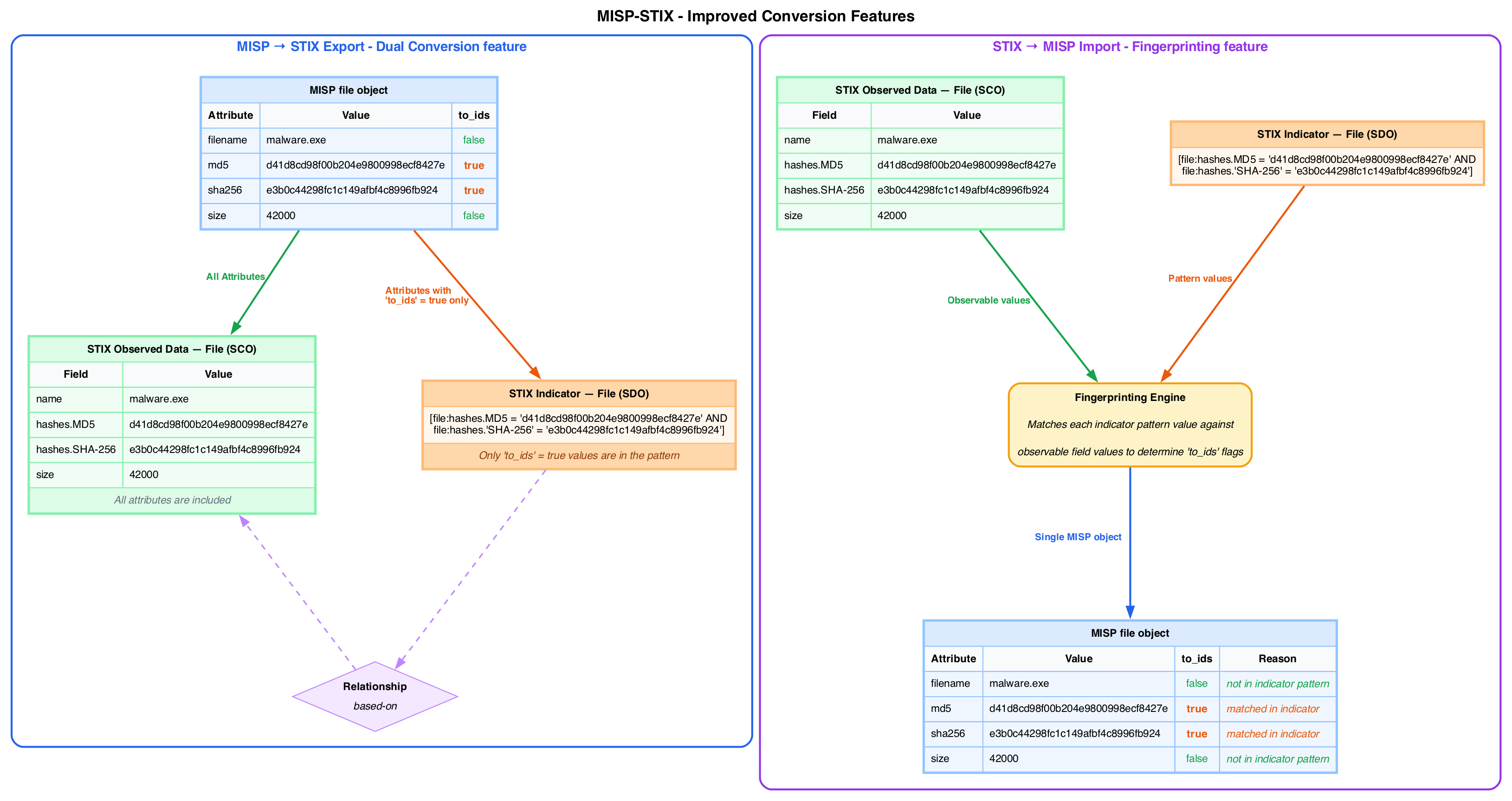
MISP-STIX 2026.11.12: MISP Extensions replace the custom STIX 2.1 content
Introduction
misp-stix is the Python library powering bidirectional conversion between MISP and STIX (versions 1.x, 2.0 and 2.1).
It is used by MISP core software, available as misp-stix on PyPI, and also available directly as a conversion service on cti-transmute.org.
Version 2026.11.12 is out. The main change is in the STIX 2.1 export: it no longer writes the custom objects and properties that STIX 2.1 deprecates. MISP content now goes into STIX 2.1 through extension definitions of MISP’s own, the MISP Extensions, and the import reads them back.
In short:
- A STIX 2.1 bundle exported by MISP no longer contains any
x-misp-*object orx_misp_*property. - The MISP attributes, objects and galaxy clusters that no STIX object represents become
misp-attribute,misp-objectandmisp-galaxy-clusterobjects. - MISP values that a standard STIX object has no property for go into one property extension on that object.
- The four extensions come with policy documentation, JSON schemas and example bundles, so anyone can validate MISP’s STIX 2.1 output and parse it.
- The 2.1 output now keeps content the custom syntax lost:
to_idsset tofalse,first_seenandlast_seen, and a cluster’s own description. - The import reads both syntaxes, so bundles written by earlier releases import as before.
- Several conversions that used to fail the whole document now lose only the faulty element, or nothing at all. Most of these fixes come from community pull requests.
Upgrade your readers too. A reader on 2026.10.12 or earlier loses content from the bundles the new version exports. This includes a MISP instance importing STIX 2.1 files exported by an upgraded instance.
Why move away from custom objects and properties?
The STIX 2.1 specification deprecates custom objects and properties (section 11) in favour of extension definitions (section 7.3). An extension definition is a STIX object of its own. It names who created the extension and gives it a version and a JSON schema, so a consumer can learn what the extended content means and check it, instead of guessing from an x_ prefix.
misp-stix kept using the custom syntax in its 2.1 export until now. This worked, but it had two problems. First, the content was opaque to anyone but misp-stix. Second, a few values were dropped along the way because the custom syntax had no place for them. This release fixes both.
The four MISP Extensions
The STIX 2.1 export now carries MISP’s own content through four extension definitions. They have fixed ids, are at version 1.0.0, and are created by the MISP Project identity (identity--55f6ea65-aa10-4c5a-bf01-4f84950d210f):
| Extension | Extension type | Extension definition id |
|---|---|---|
| MISP Attribute Extension | new-sdo, defining misp-attribute |
extension-definition--c1f2c0fa-3786-4f27-bf57-cf050ecfc104 |
| MISP Object Extension | new-sdo, defining misp-object |
extension-definition--a093107b-933f-4d72-a9a6-6d7318adadda |
| MISP Galaxy Cluster Extension | new-sdo, defining misp-galaxy-cluster |
extension-definition--573a76d8-f8a0-4f53-bc93-f2777576b7b9 |
| MISP Property Extension | property-extension, on standard objects |
extension-definition--5ece67ea-2e8b-4ed0-bb69-26d69053ee0b |
The three new-sdo extensions each define one object type for MISP content that has no STIX equivalent. The property extension is shared by every standard STIX object type MISP extends. This includes SDOs such as attack-pattern, location or threat-actor, SCOs such as file, url or windows-registry-key, and indicator, note and opinion.
What changes in the STIX 2.1 output
Custom objects become misp-* objects
x-misp-attribute, x-misp-object and x-misp-galaxy-cluster become misp-attribute, misp-object and misp-galaxy-cluster. They keep the same uuid in their id, and their properties lose the x_misp_ prefix. Each object declares its extension in extensions.
Here is a bank-account object, which has no STIX equivalent, as exported by 2026.10.12 (trimmed to two attributes, created_by_ref and labels left out):
{
    "type": "x-misp-object",
    "spec_version": "2.1",
    "id": "x-misp-object--695e7924-2518-4054-9cea-f82853d37410",
    "created": "2020-10-25T16:22:00.000Z",
    "modified": "2020-10-25T16:22:00.000Z",
    "x_misp_name": "bank-account",
    "x_misp_meta_category": "financial",
    "x_misp_attributes": [
        {
            "type": "iban",
            "object_relation": "iban",
            "value": "LU1234567890ABCDEF1234567890",
            "category": "Financial fraud",
            "uuid": "8acaad62-227a-4988-96e7-4586847421a2",
            "to_ids": true
        },
        {
            "type": "text",
            "object_relation": "institution-name",
            "value": "Central Bank",
            "category": "Other",
            "uuid": "c206e7b4-7333-40a3-bf02-9647d32f9df2"
        }
    ]
}
And the same object, as exported by 2026.11.12:
{
    "type": "misp-object",
    "spec_version": "2.1",
    "id": "misp-object--695e7924-2518-4054-9cea-f82853d37410",
    "created": "2020-10-25T16:22:00.000Z",
    "modified": "2020-10-25T16:22:00.000Z",
    "name": "bank-account",
    "meta_category": "financial",
    "attributes": [
        {
            "type": "iban",
            "object_relation": "iban",
            "value": "LU1234567890ABCDEF1234567890",
            "category": "Financial fraud",
            "uuid": "8acaad62-227a-4988-96e7-4586847421a2",
            "to_ids": true
        },
        {
            "type": "text",
            "object_relation": "institution-name",
            "value": "Central Bank",
            "category": "Other",
            "uuid": "c206e7b4-7333-40a3-bf02-9647d32f9df2",
            "to_ids": false
        }
    ],
    "extensions": {
        "extension-definition--a093107b-933f-4d72-a9a6-6d7318adadda": {
            "extension_type": "new-sdo"
        }
    }
}
Note the "to_ids": false on the second attribute. The custom syntax left it out, so the import gave the attribute its type’s default instead. The misp-* types always write to_ids, true or false. They also write first_seen and last_seen whenever MISP has them, and the attribute data in base64 whenever there is a payload.
For galaxy clusters, x_misp_description used to join the galaxy’s description and the cluster’s description into a single string. A misp-galaxy-cluster now carries them separately, as galaxy_description and description.
Custom properties move into the MISP Property Extension
When a standard STIX object cannot hold every value of a MISP object, the values left over used to go out as x_misp_<name> properties. They now go into the object’s extensions, under the property extension’s id, next to any predefined extension such as windows-pebinary-ext or socket-ext. A url object whose leftover values were x_misp_domain, x_misp_host, x_misp_ip and x_misp_port now reads:
"extensions": {
    "extension-definition--5ece67ea-2e8b-4ed0-bb69-26d69053ee0b": {
        "extension_type": "property-extension",
        "domain": "example.com",
        "host": "www.example.com",
        "misp_ip": "198.51.100.7",
        "port": "443"
    }
}
A property name is the old one without its x_misp_ prefix. Names the STIX base schema cannot take as they are get escaped. For example, a name shorter than three characters takes a misp_ prefix, so ip becomes misp_ip. The policy documentation gives the exact rules to read names back.
MISP values of objects nested inside STIX structures (a pe object and its sections inside windows-pebinary-ext, registry values inside a windows-registry-key) had no valid place in STIX 2.1. They now go into nested rooms of the property extension: windows_pebinary_ext, windows_pebinary_ext.sections and values.
Patterns follow the values
Indicators compare MISP values where the observable now holds them, through the property extension’s path:
[url:x_misp_domain = 'example.com']
becomes:
[url:extensions.'extension-definition--5ece67ea-2e8b-4ed0-bb69-26d69053ee0b'.domain = 'example.com']
The bundle carries its definitions
A STIX 2.1 bundle using a MISP Extension now includes the extension definitions it uses and the MISP Project identity that creates them, each only once. In an event, they go with the identities, ahead of the Report or Grouping. objects[1] is therefore no longer guaranteed to be the Report. Consumers should not rely on this order, nor on the definitions being present. The import recognises the extensions by their fixed ids alone.
What stays the same
- The
misp:type=…,misp:category=…,misp:name=…and other labels are standard STIX properties and do not change, so a bundle is recognised as MISP’s as before. - STIX 2.0 has no extension definitions. Its export keeps the
x-misp-*objects and thex_misp_*properties, and changes only where four fixes stop it losing content (see below).
Importing
- The Internal import (STIX produced by MISP) reads both the MISP Extensions and the custom syntax, object by object. STIX 2.1 bundles written up to
2026.10.12import into the same MISP content as before. - The import also reads extension paths in Indicators that have no Observed Data next to them, so a bundle reduced to its Indicators still imports whole.
- An identity that only creates extension definitions, like the MISP Project identity, converts to nothing in MISP. It does not become an
organizationobject. - A bundle whose MISP content sits only in property extensions now parses with
stix2.parseand its defaultallow_custom=False, which refused thex_misp_*properties. A bundle with amisp-*object still needsallow_custom=True, unlessmisp_stix_converteris imported, which registers the types.
Specification, schemas and examples
The MISP Extensions are documented in the repository, in the style of the STIX specification:
- The policy documentation describes the four extensions, their properties, naming rules and conformance notes.
- The JSON schemas are the normative definition. The directory can be given directly to
stix2_validator --schemas. - Eight example bundles, taken from the 2.1 export of test events, are validated against the schemas by the test suite.
- The packaged definition objects ship with the library.
The mapping documentation is also regenerated to describe the new 2.1 output.
More robust conversions
Several conversions used to fail the whole document because of a single faulty element. Now only that element is lost, with an Error, or it is kept.
Export
- An event galaxy that fails no longer loses the whole document, in both STIX versions. The galaxy is lost alone and its tag goes out as a label of the Report or Grouping. A 2.1 region cluster with no
-code, such asAntarctica, exports as a Location (#121). - A 2.1 annotation without text no longer raises
MissingPropertiesError. It goes out as amisp-object(#122). - An event creator (
Orgc) missing its uuid or name no longer raises aTypeError. The event exports without its creator identity, with an Error (#118). - A network socket with an out-of-enum
socket-typeordomain-familyexports asnetwork-traffic, instead of falling back to a custom object. - STIX 2.0 galaxy clusters carry
first_seenandlast_seenasx_misp_first_seenandx_misp_last_seen. Before, they went out unprefixed, which failed the document or got dropped on import.
Import
- A Sighting naming an organisation the bundle does not carry no longer loses the whole document. The Sighting is dropped with an Error, and a Sighting with no
where_sighted_refsis imported with no organisation. - An
ANDinside a quoted pattern value no longer splits the pattern. A file namedevil AND you.exeused to cost its object, and afilename|md5attribute could silently get wrong values. Every pattern reader now splits outside quoted values only (#132). - A hash MISP has no type for, such as a
CRC32next to an MD5, no longer costs its object. It is kept as atextattribute named after the hash (crc32), with a Warning (reported in #133). to_idsfrom the pattern: the values of adomain-ipobject, and the values read from an artifact (a file’s malware sample, an image’s url), now take theirto_idsfrom the Indicator’s pattern, like other observable values, instead of their type’s default.
Upgrading
pip install --upgrade misp-stix
Before upgrading, check the following:
- Python 3.11 or later is required, together with pymisp 3.0. Python 3.10 is no longer supported, and Python 3.15 now is.
pycountry26 is required.- STIX 2.1 consumers of MISP output should read the extensions instead of the
x_misp_*properties. The release notes list the migration rules, and the schemas are the reference. - Readers on
2026.10.12or earlier lose content from the new 2.1 bundles:misp-*objects, values in property extensions, analyst Opinions, and more. Upgrade them, including MISP instances importing STIX 2.1 from upgraded instances. - Do not assume
objects[1]of an event bundle is the Report.
This release has no security advisory. Every change comes with tests, and the suite now stands at 3,043 tests, run on every Python version from 3.11 to 3.15.
The full list of changes, with commit references, is in the release notes.
Acknowledgements
Many thanks to elhoim for the pull requests #118, #121, #122 and #132, and for the report in #133. Five of the fixes in this release come from these contributions.
- Source code: https://github.com/MISP/misp-stix
- Release notes: https://github.com/MISP/misp-stix/releases/tag/2026.11.12
- MISP Extensions specification: https://github.com/MISP/misp-stix/tree/main/data/misp-extensions/extension-definition-specifications/misp-5ec
- PyPI: https://pypi.org/project/misp-stix/
- Online conversion service: https://cti-transmute.org