Flexible intelligence model
Describe everything from atomic indicators and selectors to linked objects, tactics, techniques, and detailed Markdown reports.
MISP gives security teams one place to collect threat reports, connect clues such as suspicious links and files, and share their findings with the people who need them.
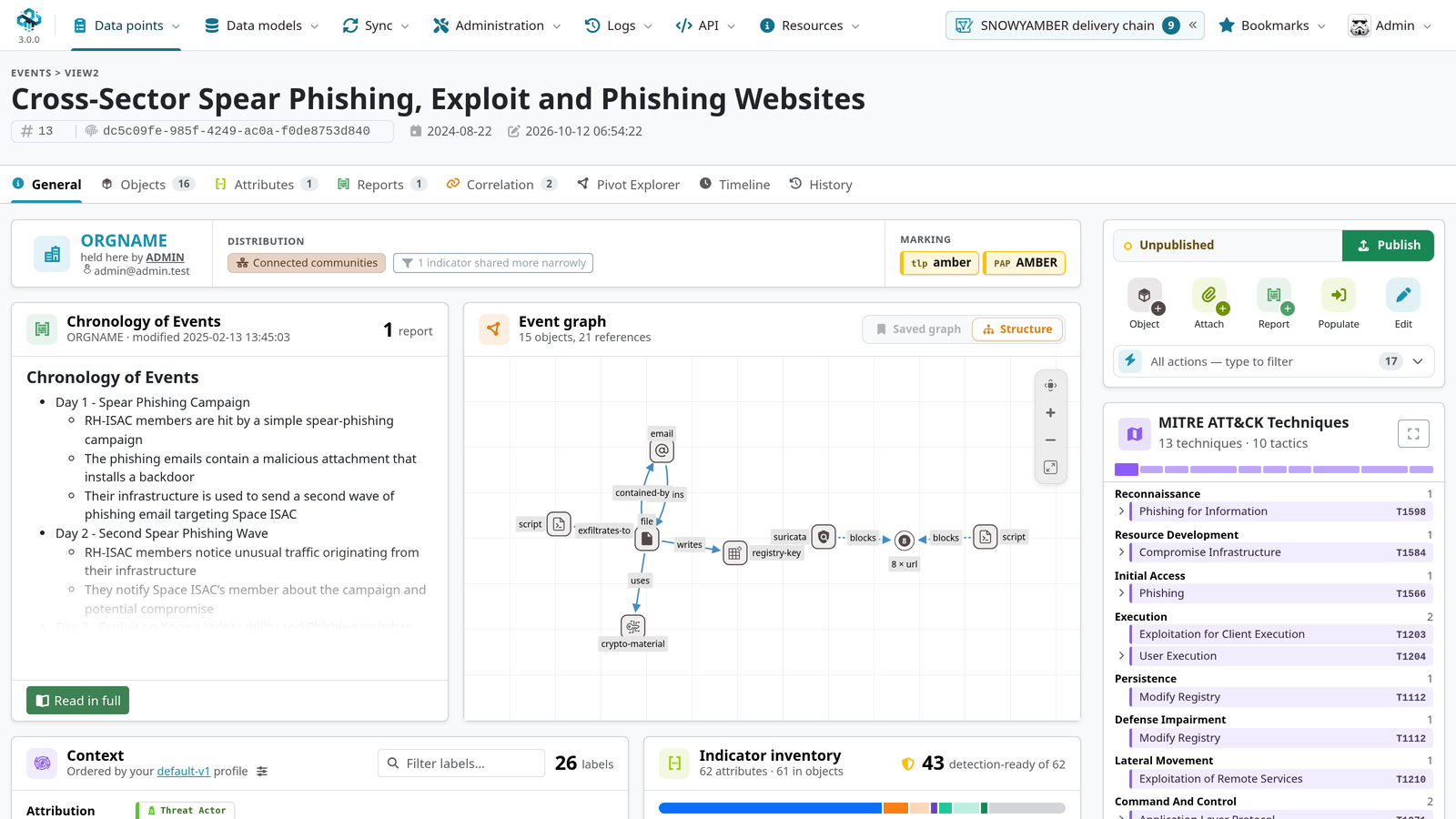
Save the report, suspicious domains, and file fingerprints (hashes) together in an event, MISP’s record of an incident or investigation.
See whether a domain or file has appeared in earlier reports. Add notes so teammates can follow what you found.
Keep the event inside your organisation or share it with trusted partners. Set narrower sharing rules for individual details when needed.
These screenshots show a MISP 3.0 test build. Use MISP 2.5 for production.
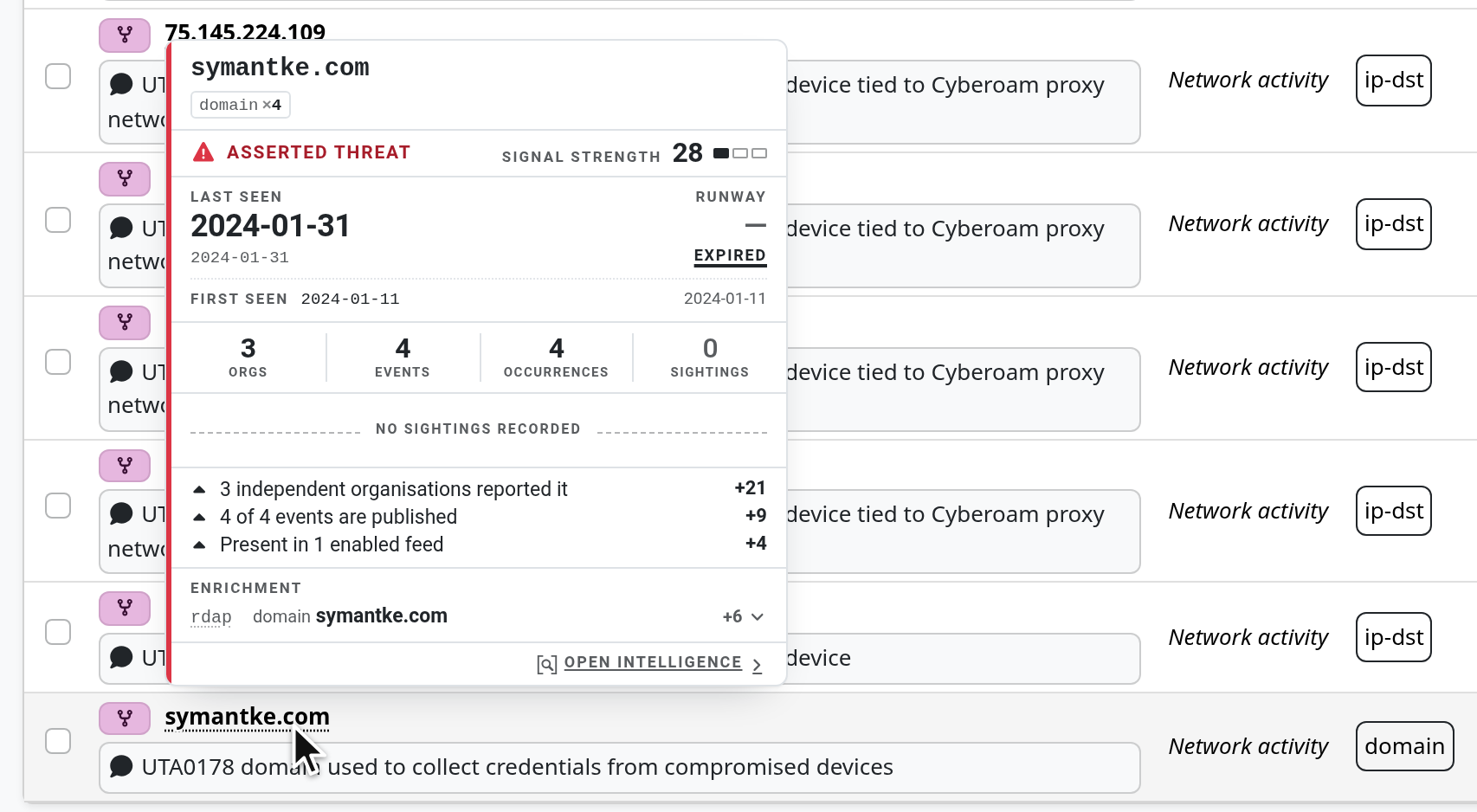
Hover over a domain to see when it was last seen, how many organisations reported it, and why MISP flagged it.
View full size of the indicator hover card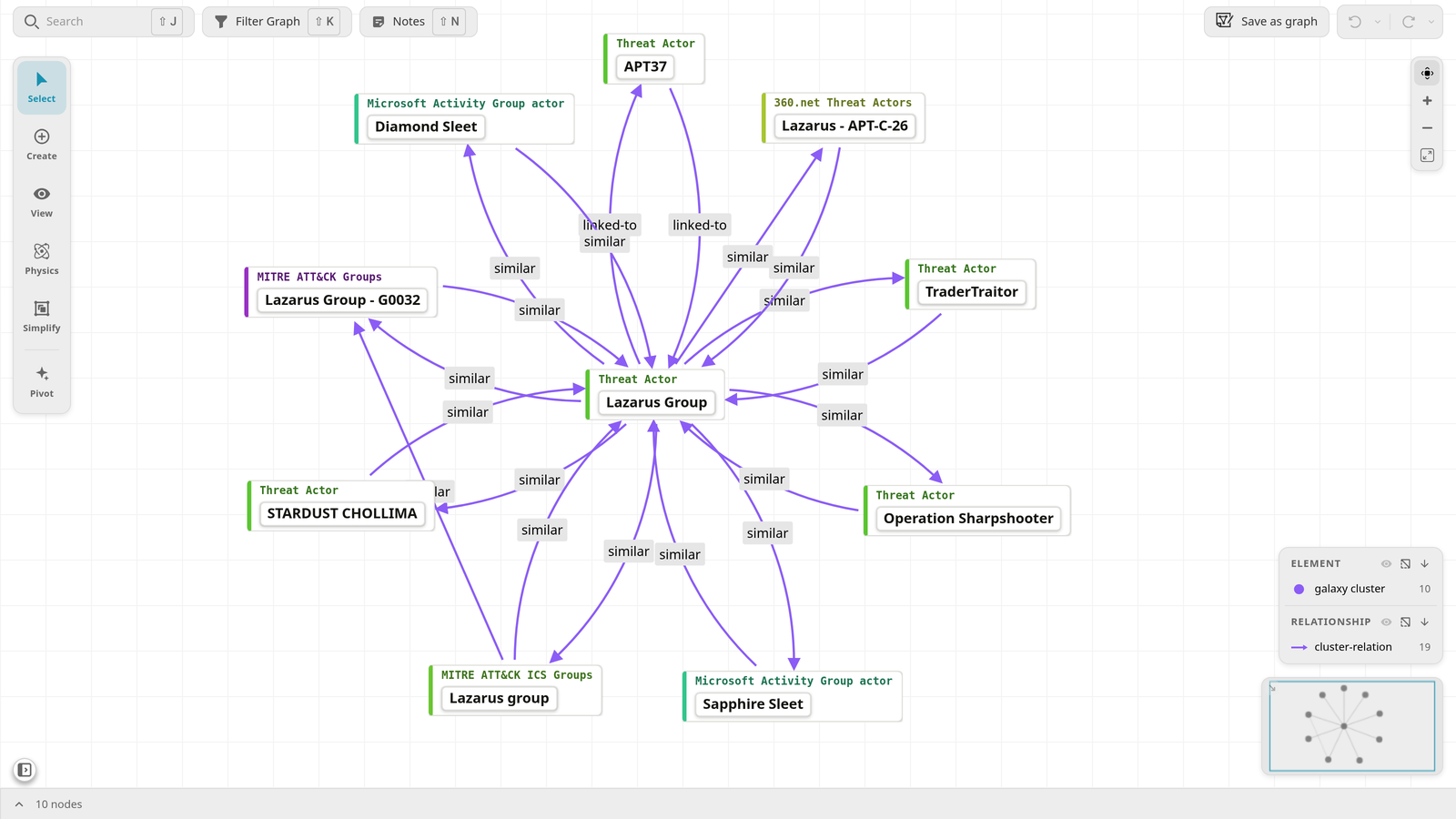
Use Pivot Explorer to move from a threat actor to related records. Save the graph to revisit or share your investigation.
View full size of the Pivot Explorer graphThe CIRCL OSINT feed publishes open-source threat reports. These screenshots show six events imported from the feed, including a report on a phishing campaign targeting hotel guests in Luxembourg.
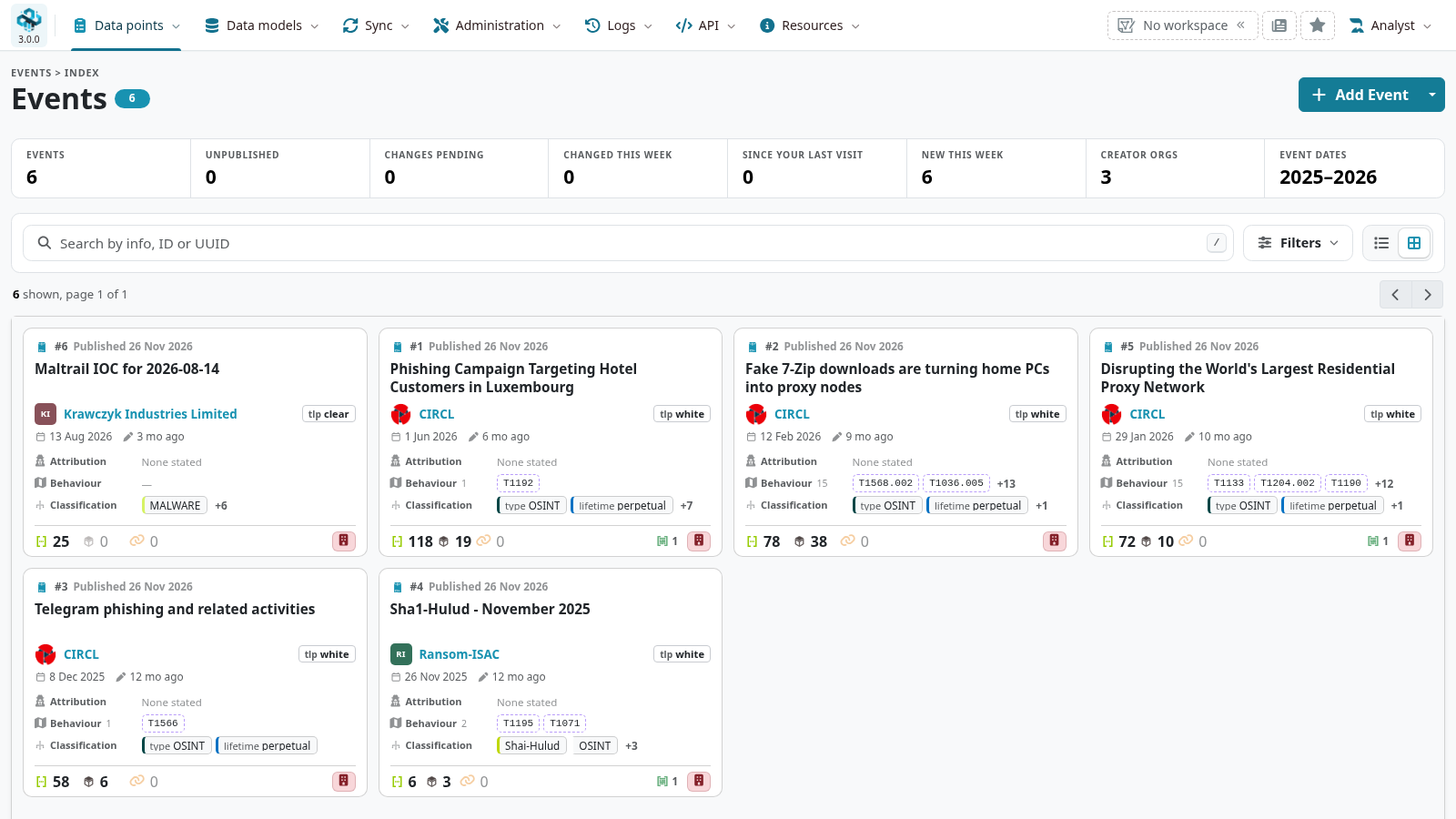
Scan each event’s title, source, tags, and indicator count before deciding which one to open.
View full size of the imported events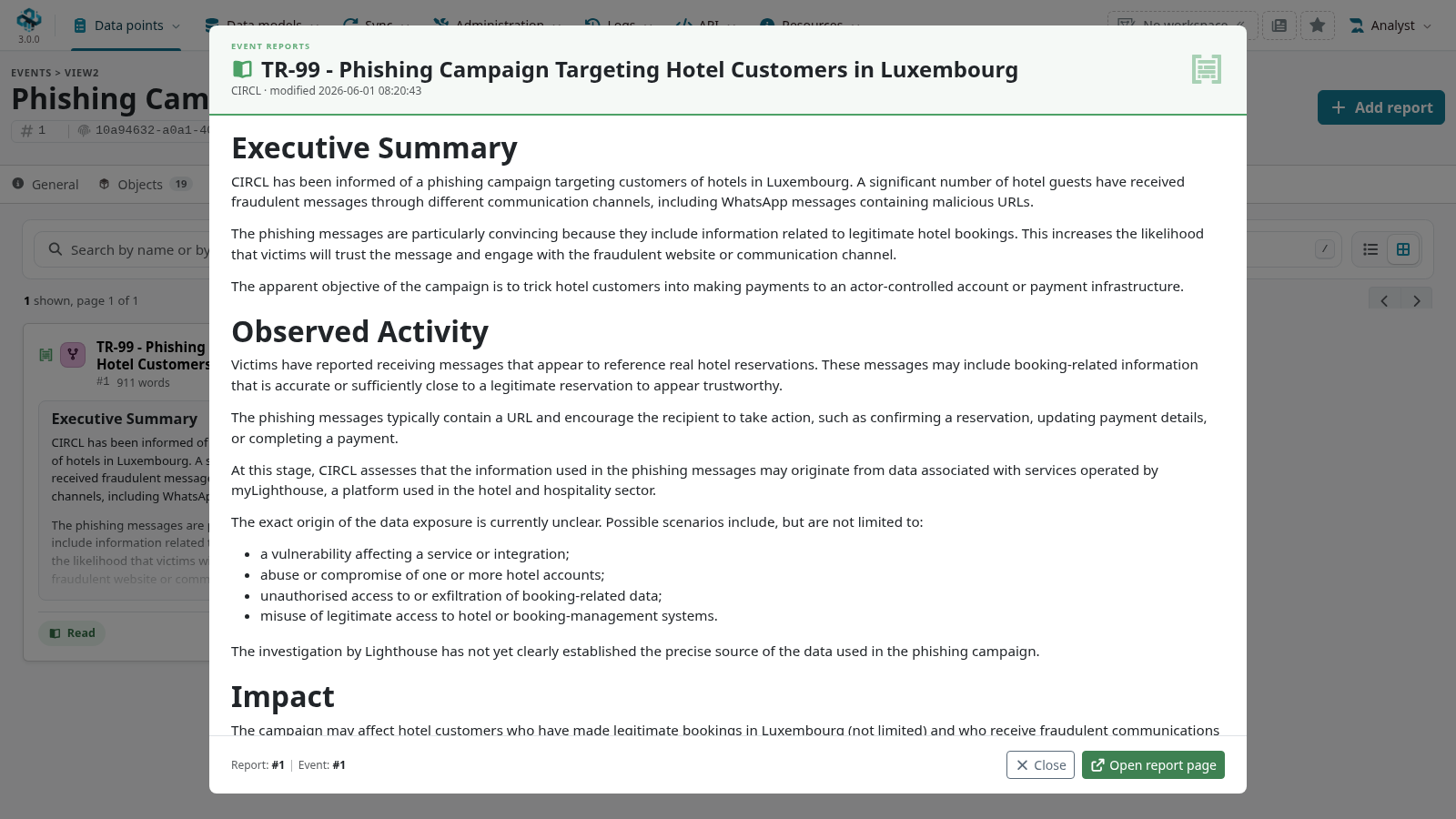
Open CIRCL’s report to understand how the campaign targeted hotel guests and why it mattered.
View full size of the CIRCL phishing reportOrganise reports and indicators, then see where the same evidence appears across investigations.
Describe everything from atomic indicators and selectors to linked objects, tactics, techniques, and detailed Markdown reports.
Reveal relationships through exact matches and advanced patterns, including fuzzy hashes and CIDR overlaps, with granular controls.
Add opinions, relationships, comments, sightings, proposals, and counter-analysis directly to shared intelligence.
Apply shareable taxonomies, warning lists, and MISP galaxies for threat actors, malware, ransomware, tools, and MITRE ATT&CK.
Navigate correlations and build event graphs that connect events, objects, and attributes into a coherent picture.
Work with teammates and trusted partners while controlling who can see each piece of information.
Use distribution levels and custom sharing groups, down to individual attributes, to match each organisation's sharing policy.
Automatically exchange events, attributes, and higher-level intelligence among MISP instances and trusted communities.
Delegate publication to a trusted community through a simple, pseudo-anonymous sharing mechanism.
Sign and encrypt notifications with GnuPG or S/MIME according to each user's preferences.
Sign and validate shared information for diverse and sensitive information-sharing communities.
Connect MISP to the security tools you already use and automate the steps you repeat.
Access all intelligence through an OpenAPI-described API, exhaustive restSearch capabilities, and the bundled PyMISP library.
Browse the API referenceBuild automatic data pipelines for qualification, analysis, modification, and publication control.
Extend MISP with Python expansion, import, and export modules or connect your own services.
Explore MISP modulesPublish new events, indicators, sightings, and tagging changes through ZMQ or Kafka channels.
Build, test, and analyse complex queries in the interface with a context-aware, templated API client.
Bring in threat data from different sources and export it in formats other teams and tools can use.
Generate MISP JSON, STIX 1 and 2, OpenIOC, CSV, text, Suricata, Snort, Zeek, RPZ, forensic cache formats, and more.
Import MISP, STIX, CSV, proprietary formats, URLs, batches, sandbox results, and bulk data through the UI or API.
Extract structured reports, objects, and attributes from unstructured text and externally hosted reports.
Rely on a stable, backward-compatible format adopted by tools and organisations around the world.
Read the MISP standardImport and export STIX 1 and 2 content through the actively maintained misp-stix library.
Explore the STIX libraryRun MISP where it suits your team, manage who can do what, and audit activity.
Run MISP on-premise, in the cloud, or as a SaaS solution for teams and communities of any size.
Create and share composable dashboards or build bespoke monitoring views in a drag-and-drop interface.
Track system and user activity with flexible logging formats and transports for centralised monitoring.
Configure permissive internal deployments or tightly regulated community instances with role-based access controls.
Use tooling for backups, identity and authentication integration, leakage prevention, and system monitoring.
Use open formats and extend MISP with tools built by its community.
MISP's contributor-owned licensing ensures the platform cannot be converted into a closed or proprietary product.
Integrate without lock-in using documented formats, open standards, and a comprehensive API.
Adapt export modules, enrichment services, taxonomies, galaxies, object templates, and workflows to your needs.
Benefit from an international community that develops software, open standards, knowledge bases, and integrations together.
Set up your own instance with the MISP documentation or find a community to share with.
© MISP project. Software released under approved open source licenses and content of this website released as CC BY-SA 3.0.